
 We live in a culture that loves to label everything. If you eat an extra slice of cake at a birthday party, someone calls it a “cheat day.” If you have a stressful afternoon at work and reach for a bag of chips, you might jokingly tell a coworker you’re “stress eating.”
But behind closed doors in my practice, these terms carry a lot more weight.
I often sit across from brilliant, highly capable people who look at me with a mix of exhaustion and confusion and ask: “Am I just greedy, am I an emotional eater, or is this something much deeper?”
If you’ve found yourself scrolling through late-night articles trying to figure out if your relationship with food is a temporary habit or a deep-rooted cycle, you aren’t alone. Let’s pull back the clinical curtain and look at the real difference between overeating, emotional eating, and binge eating—not to give you a label to hide behind, but to help you understand what your body is actually trying to tell you.
1. Overeating
Let’s start with the most common one. Overeating is, at its core, a physical event.
It happens when the food is incredibly delicious, the environment is social, or you simply missed your body’s subtle “I’m full” cues. Think of a holiday celebration, a backyard BBQ with friends, or trying a brand-new restaurant. You eat past the point of comfortable fullness, your jeans feel a little too tight, and you might think, “Oof, I definitely didn’t need that last taco.”
The Key Identifiers:
- The Presence: You are usually fully present and conscious while it’s happening. You’re talking, tasting, and enjoying.
- The Aftermath: There might be slight physical regret, but there isn’t a crushing wave of existential guilt. You don’t wake up the next morning feeling like a fundamentally broken person; you just move on with your week.
2. Emotional Eating
Emotional eating is where the nervous system enters the chat. This isn’t about physical hunger at all; it’s about using food to shift, numb, or change an internal emotional state.
You finish a brutal day at the office, or you have a tense conversation with your partner, and suddenly the pantry starts calling your name. You aren’t seeking fuel; you are seeking comfort, distraction, or a reward. Food becomes a quick, reliable way to access a hit of dopamine when reality feels a bit too sharp or draining.
The truth about emotional eating: It is a deeply human coping mechanism. In a world that demands we constantly “perform,” food is sometimes the quickest way to create a boundary of comfort around ourselves.
The Key Identifiers:
- The Trigger: It is almost always preceded by a specific feeling—boredom, loneliness, stress, or exhaustion.
- The Scale: While you might eat more than you intended, there is still a baseline level of control. You might eat half a pint of ice cream while watching a movie to soothe yourself, but you don’t feel entirely disconnected from your own body while doing it.
3. Binge Eating
This is where the shift becomes profound. The difference between overeating and binge eating isn’t just about the volume of food; it’s about the total loss of agency.
When a binge happens, it feels like an out-of-body experience. The autopilot takes over, the fog rolls in, and it feels as though someone else has taken the steering wheel. It is a desperate, biological attempt by an overwhelmed nervous system to find a temporary chemical truce from an internal pressure cooker that has become too loud to bear.
If emotional eating is a blanket, binge eating is an emergency escape hatch.
The Key Identifiers:
- The Dissociation: You often eat incredibly fast, sometimes without even tasting the food, feeling completely disconnected from the room around you.
- The Secrecy and Shame: It almost always happens in isolation, hidden from the world. The aftermath isn’t just a tight waistband—it is a heavy, suffocating wave of food shame and a deep feeling of powerlessness.
- The Restriction Loop: The morning after a binge, the immediate instinct is to build a tighter cage. You promise to restrict your food, skip breakfast, or start a strict new routine. But that very restriction creates the deprivation that triggers the next absolute depletion.
Moving From Labels to True Regulation
If you are reading this and recognizing yourself in the deeper end of this spectrum, please hear this: Your body is not broken, and you are not uniquely weak-willed.
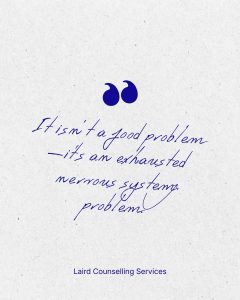
Whether it is emotional eating vs binge eating, the behavior isn’t proof of a character flaw. It is a sign that food has been forced to do the heavy lifting for emotions, chronic stress, or trauma that simply have nowhere else to go. You cannot shame yourself into a peaceful relationship with food, and you cannot discipline your way out of deep emotional exhaustion.
Real healing doesn’t come from memorizing definitions or forcing yourself into stricter rules. It happens when we step away from the kitchen entirely and start looking at how your nervous system processes safety.
Through somatic therapy for your food relationship, we work together to understand what the pressure is that your body is trying to escape from, helping you find genuine regulation without needing to numb out.
You don’t have to keep trying to fix this on your own in the dark. If you’re ready to break the loop and explore a more peaceful way of living in your body, reach out today to schedule a gentle, entirely judgment-free introductory consultation.

Cheryl is a Registered Psychotherapist focusing on body image, disordered eating, and emotional healing.