You show up. You meet the deadline. You remember the school pickup, the anniversary, the report that was due Friday. From the outside, nothing looks wrong.
From the inside, it’s a different story. Your shoulders live somewhere up near your ears. Your jaw aches by mid afternoon and you’re not sure when that started. And even after a full night’s sleep, you wake up already tired, like your body never actually clocked out.
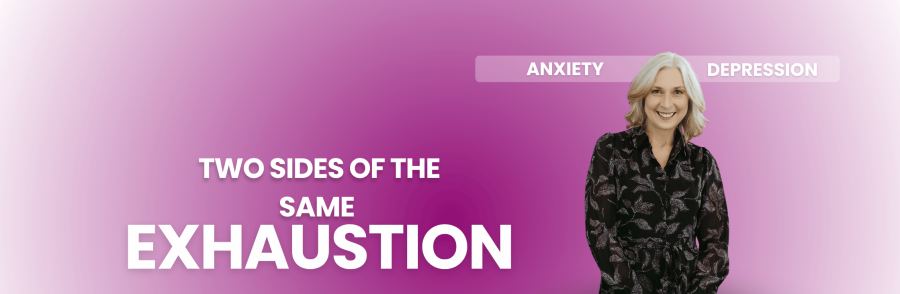
This is high functioning anxiety, and it is easy to miss, because it doesn’t look like the anxiety we’re taught to picture.
Why It Hides So Well
Anxiety that comes with a panic attack gets noticed. Anxiety that shows up as competence, over preparation, and a packed schedule usually gets praised instead.
That’s part of what makes it so exhausting to carry. There’s rarely a moment where someone else can see what it’s costing you, which means there’s rarely a moment where you feel like you have permission to put it down.
Where It Eventually Leads
Left unaddressed long enough, this kind of chronic activation doesn’t stay contained to worry alone. According to the Centre for Addiction and Mental Health, anxiety and depression frequently occur together, since a nervous system that stays on high alert for too long eventually runs out of fuel to sustain it.
That’s often when the low, flat feeling of depression enters, quietly, underneath the anxiety that’s already familiar. It can show up as losing interest in things that used to bring you joy, or a sense that you’re just going through the motions of your own life.
This Isn’t About Trying Harder
None of this responds well to willpower, because willpower was never the problem. A nervous system stuck in survival mode needs to feel safe again before it can stop running the alarm, and that happens through consistent, gentle work, not by pushing through it one more time.
Anxiety and Depression Therapy in Guelph and Online Across Ontario
If you’ve been carrying this quietly and calling it normal, you don’t have to keep doing that alone. Reach out to schedule a gentle, no pressure consultation.
We live in a world that throws the words “anxious” and “depressed” around casually. We use them to describe a stressful afternoon at work or a rainy weekend afternoon.
But behind the closed doors of my practice, I see a fundamentally different reality. I sit across from brilliant, highly capable people every day who run businesses, manage teams, and keep entire households organized—yet feel entirely paralyzed when it comes to their own internal world.
If you know that feeling, you’ve probably spent a long time blaming your willpower. You’ve told yourself that if you were just a little more disciplined, or if you tried just a little bit harder tomorrow, you could finally shake the heavy fog or stop the racing thoughts.
When you see a healthcare professional, they often use standard clinical tools like the GAD-7 screening for anxiety and the PHQ-9 for depression. But you don’t live your life inside a clinical checklist. You live it at your desk, in your car, and in your relationships. To truly find relief, we have to look past the medical numbers and address how these conditions actively disrupt your daily life.
How Anxiety and Depression Intersect to Drain Your Daily Energy
Though our culture treats anxiety and depression like opposites—one makes you wired, the other makes you low—the physical reality inside your body tells a completely different story. On a clinical scale, both conditions share massive real estate: poor sleep, an overwhelming lack of energy, trouble concentrating, and intense physical restlessness.
In daily life, this looks like high-functioning anxiety running your battery straight into the ground. You wake up after eight hours of sleep feeling like you haven’t rested in a year. The most basic tasks feel like hiking up a mountain through deep mud. Your system is running on empty because it is burning all its fuel just trying to survive.
Why Does Your Mind Turn Everyday Worries Into a High-Stakes Survival Situation?
When anxiety takes over, clinical measures focus on feeling nervous or on edge, an inability to stop or control worrying, and a persistent feeling that something awful might happen. In your everyday routine, this is your body’s internal alarm system getting permanently jammed on the high setting. It feels like living with an invisible baseline hum of static electricity right beneath your skin.
Your shoulders are up to your ears, your jaw is permanently clenched, and your mind feels like a game of toxic Whack-A-Mole. The moment you solve one problem, your brain immediately transfers that exact same level of panic to a new target. Your mind is simply trying to create thoughts that match the high level of adrenaline pumping through your system.
The Depressive Fog: Why Chronic Exhaustion Quietly Shuts Down Your Motivation
When the system completely burns out from holding that anxiety static at bay, the symptoms of depression roll in. Clinical diagnostic tools look for little interest or pleasure in doing things, feeling down or hopeless, and feeling like a failure who has let everyone down.
This is the exact moment the engine shuts off entirely.
Depression pulls a heavy veil over the world, making the hobbies, conversations, and routines that used to bring you genuine joy feel completely flat and empty. It whispers a cruel lie into your ear: that you are a burden, and that tomorrow will feel exactly like today. It strips away your ability to stay present, leaving you feeling entirely isolated even in a room full of people who love you.
Why True Relief Requires Moving Away From Rigid Rules and Toward Nervous System Regulation
Your struggle with your mental health isn’t heavy because you lack character or strength. It’s heavy because your nervous system has been forced to do the heavy lifting for chronic pressure, stress, or old hurts that have nowhere else to safely go. You cannot fix an internal conflict rooted in pain by forcing yourself into a tighter cage.
Real healing doesn’t come from forcing yourself into a stricter routine to fix a body that is crying out for rest.
It happens when we step back from the daily rush and move away from rigid rules toward genuine nervous system regulation. When your body learns how to process stress without entering a state of total survival overwhelm, your day-to-day functioning naturally begins to soften.
Do You Want to Reclaim Your Day-to-Day Focus?
At my clinic, therapy for anxiety and depression is focused entirely on creating safety. Instead, we work with you to understand what the invisible pressure is that your system is trying to protect you from, helping your body find true relief in a sustainable, gentle way.
You don’t have to keep struggling your way through the daily static, and you don’t have to carry this heavy armor alone. If you are ready to break the cycle and find a peaceful way forward, reach out to us today to schedule a gentle, entirely judgment-free introductory consultation.