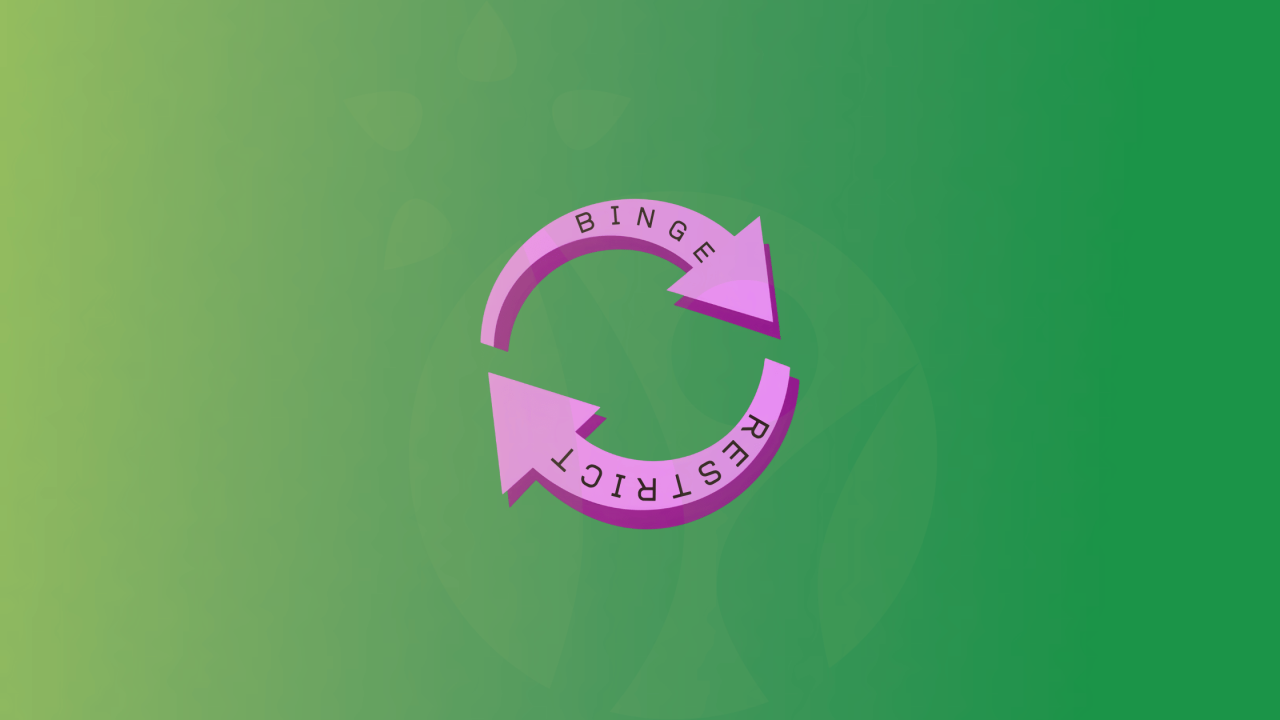
Why “Just Eat Less” Doesn’t Work: Understanding the Restrict-Binge Cycle
If you’ve ever eaten past full and wondered how you “let it happen” again, the honest answer often traces back to what happened before that moment, sometimes hours before, sometimes years before.
What restriction actually is
Restriction is a state of deprivation, physical and mental. It can look like skipping meals, cutting out entire food groups, or simply telling yourself certain foods are off-limits. Whatever the form, the body and mind both register it as scarcity.
Bodies respond to scarcity by pushing back
Bodies are built to respond to scarcity like this. A body that has been deprived of food, or of permission to eat certain foods, will often push hard toward exactly what was restricted. What looks like “losing control” is frequently the predictable result of the restriction that came before it.
If a hard day ever calls for something to reach for in the moment, a few grounding tools for difficult days can help before the spiral takes over.
Why treating the binge alone rarely works
Many approaches focus entirely on stopping the binge: more discipline, stricter rules, more willpower. But if restriction is what’s driving the cycle, adding more restriction on top of it usually feeds the exact pattern it’s meant to fix. It’s a bit like pulling a rubber band tighter to stop it from snapping back.
Understanding this cycle is often the turning point clients describe in their first few sessions of online therapy for disordered eating across Ontario.
What actually helps
Breaking the cycle usually means addressing the restriction side first, whether that’s rigid food rules, skipped meals, or an all-or-nothing mindset about “good” and “bad” foods. As the restriction eases, the intensity of the binge side often eases with it. This is slower and less dramatic than a new diet, but it holds up over time in a way another round of restriction rarely does.
If this cycle sounds familiar, understanding it is the first real step out of it. Reach out to Laird Counselling Services for a free consultation to learn more about how we can help. You can also read more about what therapy for your relationship with food actually looks like.
Common questions
Does breaking the cycle mean giving up dieting completely?
Not necessarily right away, but most approaches that break the restrict-binge cycle involve loosening rigid food rules over time, since those rules are usually what’s fueling the cycle.
How long does it typically take to see change?
This varies by person, but many clients notice a shift in the intensity of the cycle within the first several weeks of consistent work, even before the pattern fully resolves.